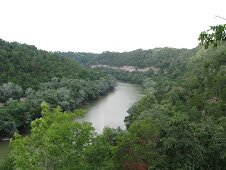
The river was once a source of life, a clear, sustained note resounding in every inhabitant’s daily existence. Its current rhythmed vital domains of life and community. Today, however, the place of the river in the geo-mental schemata of inhabitants has undergone some profound re-channeling. Once an economic and cultural conduit connecting inhabitants of the High Bridge area to distant peoples and places, the river is no longer a vital component of the community’s infrastructure. Instead, the river serves mostly the recreational whims of anyone with a boat. Most people living in and around central Kentucky give very little thought to the fact that their daily lives depend on the river—and therefore, on its overall health—as it is the major source of water for most of the towns and cities located along its 259-mile course. With each turn of the faucet, we are indebted to the river. Likewise, with each flush of the toilet, we are indebted to the river. Each day, we consume millions and millions of gallons of its water, and each day millions and millions of gallons of treated (and, unfortunately, untreated) effluent returns to its flow. You need only travel a few miles upstream from Lock seven to experience the awe of what seems to be complete isolation from the workings of humankind. As one of the main arteries out of the mountains in Eastern Kentucky, the flora along the river’s corridor is representative of the incredible diversity of flora in Appalachia. Unfortunately, and without much effort, your sense of awe is despoiled by residue of human waste: plastic bags, deposited during high water, left hanging out to dry in tree limbs that overarch the bank; plastic motor oil containers—known locally as “Kentucky Ducks”—that raft along the banks; plastic and rubber balls of all sizes floating among the flotsam. In the winter, trash is visible everywhere. In the summer, thick foliage subsumes the litter but doesn’t make it go away. All of these things represent the rotten fruits of living a life predicated on consumption and creation of waste.
That people seem to give very little thought to their places and the relationship between their choices and actions and the relative health and appearance of the environment should come as little surprise, particularly in light of Berry’s notion about the impulse to keep moving that dominates contemporary American life. One’s place in the world is reduced significantly when one is in constant motion. Place becomes personal, private, isolated, disconnected. One’s responsibility, then, is truncated, too. The greatest deception of industrial and post-industrial civilization has been to divorce human consciousness from the natural world, a split that imperils every living organism. But, as Jack D. Forbes points out, our well-being and ultimate survival relies not on our functioning as autonomous creatures but on our behavior as symbiotic organisms:
I can lose my hands and still live. I can lost my legs and still live. I can lose my eyes and still live. I can lose my hair, eyebrows, nose, arms, and many other things and still live. But if I lose the air I die. If I lose the sun I die. If I lose the earth I die. If I lose the water I die. If I lose the plants and animals I die. All of these things are more a part of me, more essential to my every breath, than is my so-called body. What is my real body? (145)
For the residents of High Bridge and the surrounding region, if we lose the river, we die. Granted, the river is older than modern humans, and barring the complete destruction of the earth, it will survive in some form or fashion, long after humans have vanished from the earth. But it is a vital resource, and the quality of our lives depends directly on the quality of its water.
Wednesday, September 2, 2009

Installment Three
I have left my ancestral home-place several times in search of my place in the world. In my case, the decisions to leave were based solely on the desire to advance professionally. In academia, my chosen profession, common wisdom has it that worthwhile, long-term opportunities are only found elsewhere. Nestlings must leave the nest if they are to take wing, fly, and find territory of their own. Usually, these flights of maturation and identity are significant, take you out of your region and land you in unfamiliar places.
Once you’ve been away for a while, learning the rhythms and resonances of a new place and reliving your old place only in memories, it is easy to recognize change. Each time I return to central Kentucky to visit my parents, I can feel the shifting sand. Fences aren’t where they were before. Old trees are gone. Bulldozers have reconstituted entire hills. Houses spring up in fields I thought cows would graze for eternity. Tobacco fields are subdivided and given quaint names that identify precisely what has been lost: “Rabbit Run,” “Quail Covey,” “Dogwood Trace,” and “Tranquil Estates.” And no one, I mean no one, farms anymore. Once the region’s cultural pride and primary source of income, tobacco farming has gone the way of the condor, if you’ll pardon the expression.
Until only very recently, I farmed tobacco with my father and older brother on a piece of land that borders the Kentucky River. In the days before paved, four-lane highways, the river was the primary means for area farmers to transport their crops to warehouse markets downstream. While this aspect of the river’s utility to farmers disappeared long before I came onto the scene, the importance of the river as a geological and cultural landmark, with its breath-taking palisades and vistas, isolated bottom-lands, and mysterious, remote, yet invitingly lush tributaries, still reverberates in my consciousness in concentric waves. And a large part of my value and respect for the river is tied to knowledge of its past, how it intersected the lives of my predecessors and helped sustain their humble yet fulfilling ways of life.
I’m certain that my predecessors would think me incredulous should I suggest that small farm operations, small family tobacco farms are disappearing along the Kentucky River and that most probably will be all but extinct within my lifetime. Incredible, yes, but sadly true. Tobacco simply isn’t profitable for a small farmer anymore. My father was the holdout, too, the last of the old-time dirt farmers in High Bridge to hang it up for good. Unfortunately, the demise of tobacco farming is in keeping with the trend of this place. At this point in time, the rich, fertile land that supported generations is rapidly becoming a new generation’s El Dorado—developers’ dream-tracts of rolling meadows, cheaply obtained, easily subdivided and sold for incredible profit. Short-term, monetary gain is replacing the long-term, agrarian commitment that protected and maintained the land and sustained the small communities and families.
Once you’ve been away for a while, learning the rhythms and resonances of a new place and reliving your old place only in memories, it is easy to recognize change. Each time I return to central Kentucky to visit my parents, I can feel the shifting sand. Fences aren’t where they were before. Old trees are gone. Bulldozers have reconstituted entire hills. Houses spring up in fields I thought cows would graze for eternity. Tobacco fields are subdivided and given quaint names that identify precisely what has been lost: “Rabbit Run,” “Quail Covey,” “Dogwood Trace,” and “Tranquil Estates.” And no one, I mean no one, farms anymore. Once the region’s cultural pride and primary source of income, tobacco farming has gone the way of the condor, if you’ll pardon the expression.
Until only very recently, I farmed tobacco with my father and older brother on a piece of land that borders the Kentucky River. In the days before paved, four-lane highways, the river was the primary means for area farmers to transport their crops to warehouse markets downstream. While this aspect of the river’s utility to farmers disappeared long before I came onto the scene, the importance of the river as a geological and cultural landmark, with its breath-taking palisades and vistas, isolated bottom-lands, and mysterious, remote, yet invitingly lush tributaries, still reverberates in my consciousness in concentric waves. And a large part of my value and respect for the river is tied to knowledge of its past, how it intersected the lives of my predecessors and helped sustain their humble yet fulfilling ways of life.
I’m certain that my predecessors would think me incredulous should I suggest that small farm operations, small family tobacco farms are disappearing along the Kentucky River and that most probably will be all but extinct within my lifetime. Incredible, yes, but sadly true. Tobacco simply isn’t profitable for a small farmer anymore. My father was the holdout, too, the last of the old-time dirt farmers in High Bridge to hang it up for good. Unfortunately, the demise of tobacco farming is in keeping with the trend of this place. At this point in time, the rich, fertile land that supported generations is rapidly becoming a new generation’s El Dorado—developers’ dream-tracts of rolling meadows, cheaply obtained, easily subdivided and sold for incredible profit. Short-term, monetary gain is replacing the long-term, agrarian commitment that protected and maintained the land and sustained the small communities and families.
Tuesday, September 1, 2009
Changing Patterns of Community
Like my father’s father and his father’s father, I am from a particular place along the banks of the Kentucky River. The community of High Bridge experienced its heyday long before I was born. In fact, over the course of my father’s life, key features that typically come to mind when we think of community—a market, grocery or country store, a post office, a garage, a train station—had already vanished. By the time I was born, only the oldest residents harkened back to those heydays. Before every household owned an automobile, passenger trains stopped 4 and 5 times a day, connecting citizens of this rural, river community with larger cities to the north or south; and on weekends, excursion trains brought sightseers and day-trippers down from Cincinnati to take in natural beauty of ancient cliffs and the confluence of the Dix and Kentucky Rivers, or to dance in the historic pavilion of High Bridge park, attend Sunday camp-meetings or simply marvel at the engineering feat of High Bridge. The train station was abuzz with arrivals and departures, and, for the most part, people living in High Bridge welcomed travelers, sightseers, and day-trippers alike. The river, the palisades, and the bridge had put this place on the map.
When I was four, High Bridge lost its Post Office and its own ZIP code, 40330. By the time I was five, the last general store went out of business. When I was a teenager, public access to the bridge was prohibited. Just in the last several years, Lock and Dam No. 7 has been permanently sealed with concrete, like most of the locks in the upper half of the Kentucky, its massive steel lock-gates welded shut. My father laments that he doesn’t know “a damned person in High Bridge anymore.” As in many small communities across America, young people grow up and move away to find opportunities elsewhere. I know this. I’m one of them.
In America today, everybody, at some point in life, lives in a sort of educational, economic or professional diaspora. Wendell Berry, Kentucky’s most renowned public intellectual, identifies two competing tendencies in American cultural. The weaker tendency belongs mostly to our ancestors, those first-comers who saw a beautiful, rich, open landscape before them and said, “No farther. This is the place” (4). He notes that this was also the tendency of Native Americans—to see the intrinsic, life-sustaining, domestic possibilities of a place and settle wholeheartedly into the rhythms and resonances of that place. The stronger of the two tendencies, and the one that seems to hold sway over our current culture, however, is what Berry calls “some version of the search for El Dorado” (4). The allusion is to the early Spanish explorers on the North American continent, who were looking for gold, which was, maddeningly, always somewhere else, somewhere over the next rise, across the next river, beyond the next plain—somewhere beyond the edges of the map. Today, our continent has been mapped down to the last pebble, yet the tendency to see our own places as existing somewhere “out there” persists and we persist, as Berry notes, “with largely the same motives and with increasing haste and anxiety, to displace ourselves—no longer with unity of direction, like a migrant flock, but more like the refugees from a broken ant hill” (3).
When I was four, High Bridge lost its Post Office and its own ZIP code, 40330. By the time I was five, the last general store went out of business. When I was a teenager, public access to the bridge was prohibited. Just in the last several years, Lock and Dam No. 7 has been permanently sealed with concrete, like most of the locks in the upper half of the Kentucky, its massive steel lock-gates welded shut. My father laments that he doesn’t know “a damned person in High Bridge anymore.” As in many small communities across America, young people grow up and move away to find opportunities elsewhere. I know this. I’m one of them.
In America today, everybody, at some point in life, lives in a sort of educational, economic or professional diaspora. Wendell Berry, Kentucky’s most renowned public intellectual, identifies two competing tendencies in American cultural. The weaker tendency belongs mostly to our ancestors, those first-comers who saw a beautiful, rich, open landscape before them and said, “No farther. This is the place” (4). He notes that this was also the tendency of Native Americans—to see the intrinsic, life-sustaining, domestic possibilities of a place and settle wholeheartedly into the rhythms and resonances of that place. The stronger of the two tendencies, and the one that seems to hold sway over our current culture, however, is what Berry calls “some version of the search for El Dorado” (4). The allusion is to the early Spanish explorers on the North American continent, who were looking for gold, which was, maddeningly, always somewhere else, somewhere over the next rise, across the next river, beyond the next plain—somewhere beyond the edges of the map. Today, our continent has been mapped down to the last pebble, yet the tendency to see our own places as existing somewhere “out there” persists and we persist, as Berry notes, “with largely the same motives and with increasing haste and anxiety, to displace ourselves—no longer with unity of direction, like a migrant flock, but more like the refugees from a broken ant hill” (3).
High Bridge: From Pangaea to the Palisades
On the super-continent of Pangaea, there were no children throwing rocks into the water off High Bridge. There were no men and women dancing on the Falls City paddlewheel, no grandmothers shouting “amens” from the front pew of the Union Church. There were no houses, no religions, no railroads, no 40330 zip code, and no destinations on the map. Just a place on earth—an area of rock and sand swirling and resettling beneath the calm, warm waters of an ancient inland sea. At that time, nearly half a billion years ago, Baltica (the continent of Europe) was drifting closer to ancient North America, and the ocean floor separating the two masses was slowly subducting beneath the North American continental shelf, pushing up a chain of very steep and extremely tall mountains, the Appalachians. As the continents buckled, the inland sea gradually retreated to the west, leaving a network of ancient rivers flowing out of the mountains across a marshy plain (in present day Ohio and Indiana), emptying at last into this ever-shrinking, ancient body of water at a point north of Madison, Indiana, much farther north and east of its present confluence with the Ohio River at Carrollton, Kentucky (Ellis 39). What is now the Kentucky River was but a tributary of the larger ancient Teays River system that passed through a tropical paradise of dense rain forests, swamps and marshlands. At that time, the geographical area we know as the state of Kentucky lay squarely on the Earth’s equator. Over the course of hundreds of millions of years, after tectonic shifts further meted out the continents, the Cincinnati Arch (a geological upheaval in central Kentucky beginning in the Pliocene epoch 10 million years ago and lasting until the Pleistocene epoch some 600,000 years ago) and the cyclical grind of glaciation redirected the Kentucky River’s flow (Ellis 1), integrating it with the early Ohio River, and creating the course of the river as we know it today: a deep meander, winding from its headwaters in southeast Kentucky northwest to its mouth at the Ohio River.
Anyone who has experienced the Kentucky River, particularly between Lock & Dam seven and eight, has seen firsthand, the dramatic result of 500 million years of water leaving its mark on a place. The palisades section of the Kentucky River, with its 300 foot cliffs of Ordovician limestone, is not only of great geological import; the layering of human presence has left a mark on this place every bit as profound as the river itself, displaying the evolution of humankind’s conceptualization of our place in relation to the natural world. Written into this landscape of sheer cliffs, forested bluffs, open bottom-land and cool hollows hidden in shadow, is a catalogue of human responses, spanning eons, to the incredible forces of nature. Sometimes the human response has been one of wonderment and awe, or humility, or respect, or even fear. At other times, the response has been arrogance, vanity, vulgarity, disrespect, and even contempt for nature, for the environment—for this place.
Anyone who has experienced the Kentucky River, particularly between Lock & Dam seven and eight, has seen firsthand, the dramatic result of 500 million years of water leaving its mark on a place. The palisades section of the Kentucky River, with its 300 foot cliffs of Ordovician limestone, is not only of great geological import; the layering of human presence has left a mark on this place every bit as profound as the river itself, displaying the evolution of humankind’s conceptualization of our place in relation to the natural world. Written into this landscape of sheer cliffs, forested bluffs, open bottom-land and cool hollows hidden in shadow, is a catalogue of human responses, spanning eons, to the incredible forces of nature. Sometimes the human response has been one of wonderment and awe, or humility, or respect, or even fear. At other times, the response has been arrogance, vanity, vulgarity, disrespect, and even contempt for nature, for the environment—for this place.
Welcome to the motherblog
Hi, folks. Once you've set up a gmail account and created your personal blog, search for my blog--http://1010placespace--and become a "friend." Then I'll be able to follow your blog, see what you're thinking about and writing in relation to our class and assignments! Please feel free to personalize your blog as you see fit. Add pictures and links that you think others might be interested in, but keep in mind that this is a public space, too. Not only that, it's a space directly associated with an academic course.
I look forward to working with each of you, helping you develop as thinkers and writers, and watching as you develop your blogs!
I look forward to working with each of you, helping you develop as thinkers and writers, and watching as you develop your blogs!
Subscribe to:
Posts (Atom)